PhytoPi Controlled Environment System
Raspberry Pi system that monitors and controls an indoor plant enclosure, with a C controller, SQLite, Supabase sync, Flutter kiosk, mobile and web apps, and an AI plant-health worker. I designed the system and wrote its software.
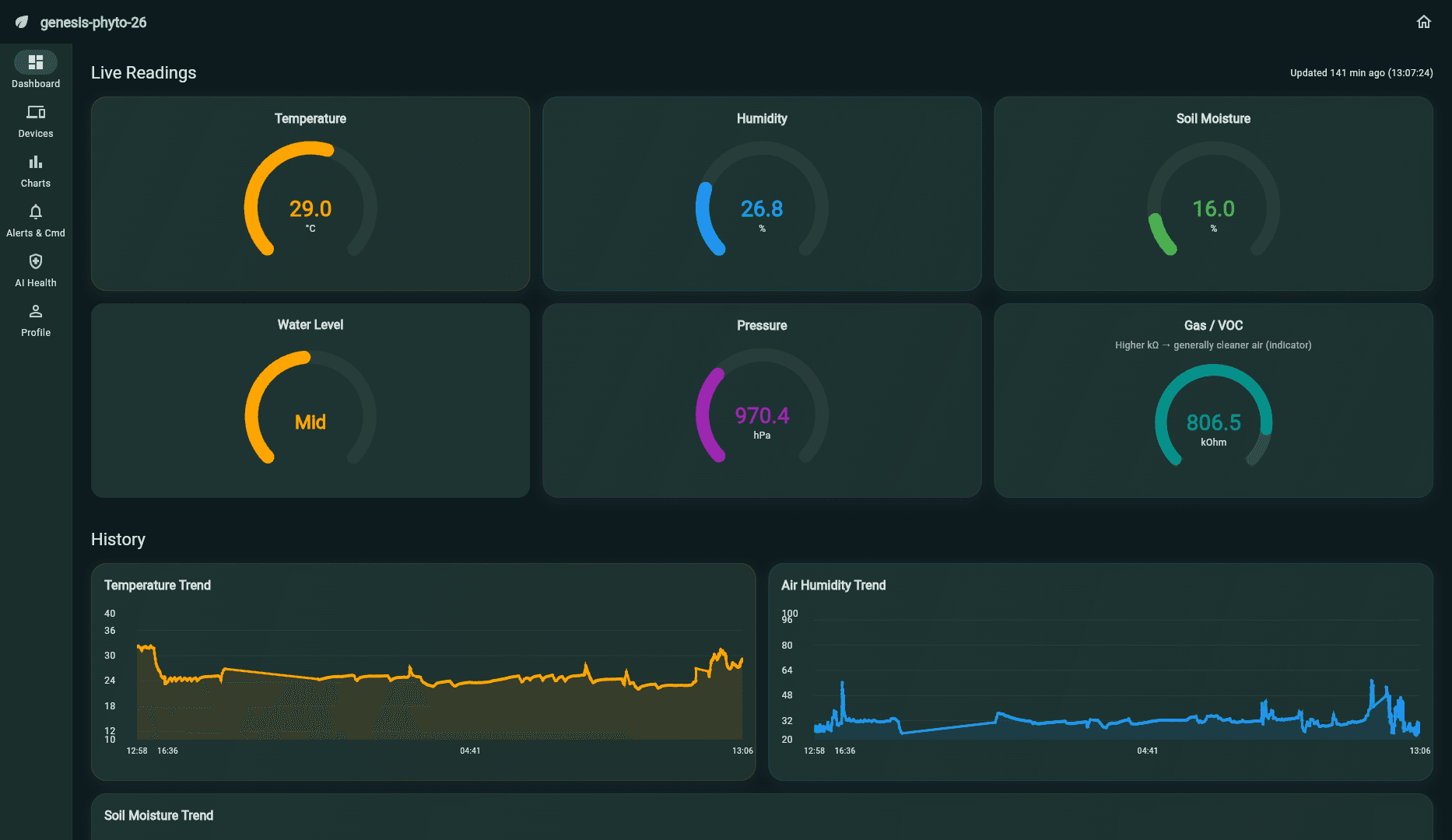
Web dashboard for live telemetry, charts, and device health.
Project overview
PhytoPi is an IoT automated plant-care system. It senses environmental conditions, analyzes trends, and triggers adjustments like irrigation, while giving you a fast, real-time dashboard. The project site is at phytopi.com.
It was my two-person capstone at Grand Canyon University. I designed the software and hardware architecture and implemented all of the software. My teammate built the hardware.
How it works
- Sense: collect environmental readings and camera snapshots.
- Analyze: detect trends and anomalies.
- Actuate: trigger adjustments to lighting, ventilation and watering.
- Alert: notify users and log actions for verification and troubleshooting.
The system monitors soil moisture, light levels, temperature, humidity, the water reservoir, and plant health through the camera.
Architecture: edge, cloud, dashboard
PhytoPi is a split system: an on-device stack for sensing and actuation, and a cloud backend for sync, history and remote access.
- Edge: a C controller on the Raspberry Pi reads the sensors, stores readings in SQLite, and drives the actuators. A kiosk screen on the device shows the same dashboard.
- Data pipeline: readings and images are stored locally first, then synced to Supabase (PostgreSQL) for history and remote dashboards.
- Control: settings changed in the kiosk, mobile and web apps flow back through Supabase to the device, which applies them to lighting, ventilation and watering.
What I built
- C controller that stores sensor readings in SQLite and syncs with Supabase, plus a TypeScript edge function for alert notifications.
- Flutter kiosk, mobile and web apps with authentication, live sensor charts, device settings, alerts and an AI Health screen.
- AI plant-health worker in Python that sends camera captures to a local Ollama vision model (Moondream) and falls back to the PlantNet API when the species answer is low-confidence.
- CI/CD with GitHub Actions that ran pytest and C tests on every push. Merges to main automatically updated the Raspberry Pi, which pulled, rebuilt and restarted the C controller and Flutter UI.
- Docker containers and systemd services so the Pi, Linux and macOS environments matched and the controller and UI start on boot.
Testing
I tested with pytest and Flutter test, and ran the full loop on real hardware: sensor readings on the Pi, sync to Supabase, display in the kiosk, mobile and web apps, and settings flowing back to control the device. We presented the project at Capstone Showcase.
Design targets
These were the capstone's design targets and budget figures, not measured results:
- At least 80% less manual plant-care labor.
- Dashboard refresh under 2 seconds.
- At least three plant-health metrics tracked.
- Optimized unit cost of $250 or less; prototype hardware spend was $557.88 across 22 logged purchases.
Scope and limits
PhytoPi is a completed capstone prototype, not a product with customers. In my own testing, with the PlantNet fallback in place, the worker returned the correct species for nearly every plant I tried. I did not record a formal accuracy figure. Some design diagrams above come from earlier design phases and differ in detail from the final build.
Project Details
- Role
- System design and all software (two-person capstone)
- Timeline
- September 2025 – April 2026
- Status
- Completed capstone · presented at Capstone Showcase
- Technologies
- CPythonTypeScriptRaspberry PiSQLiteSupabase (PostgreSQL)Flutter / DartOllamaDockerGitHub Actions
Links
- Repository
- https://github.com/DanielAndi/PhytoPi
- Live site
- https://www.phytopi.com/